FABcast


Showing posts with label community. Show all posts

Tuesday, December 17, 2019

Dr. Brené Brown’s “Dare to Lead” and Restoration Ministry

Dr. Brené Brown’s 2018 book “Dare to Lead: Brave work. Tough conversations. Whole hearts” highlights two of her most prominent topics; namely, courage and vulnerability. From a recovery ministry perspective, this book can be interpreted as an exhortation on faith (dare to lead), sanctification (brave work), confession (tough conversations, and restoration (whole hearts).


The audiobook format allows for listeners to experience the background behind her grounded theory research. She candidly explains the good, the embarrassing, and the ugly from her own life. Dare to Lead is no pie-in-the sky theoretical framework; it contains real-life examples of daring leadership. Dr. Brown’s version of “picture the audience naked” while speaking in public is brilliant. She pictures her audience metaphorically naked; that is, without their titles accomplishments positions etc. She pictures what someone looks like as a vulnerable child.[1]


Like Brown’s new perspective of an audience that set her free from fear, I experienced something very powerful that changed my outlook – it occurred right after I became fully known in my marriage and in my church small group. I began seeing others without their titles and accomplishments after gaining momentum in the business of helping people find lasting freedom from destructive behaviors in my job as a chaplain/pastoral counselor. I increasingly became fearless the more I heard raw stories and fearless moral inventories.


Today, I no longer fear people because in my job as a daring leader, I have “…met way too many people who let me all the way in to know that there could be someone else who is not like the rest of us; broken and in need of healing and restoration.” This is my mantra, which keeps me living courageously and free from the fear of man. What Dr. Brown calls “daring leadership” is, from my perspective, describing the “abundant life,” which is also “human flourishing” or what Jews refer to as shalom. She writes this for “leaders,” but concept applies to anyone who takes responsibility for investment in people.


“One of the most important findings of my career is that daring leadership is a collection of four skill sets that are 100 percent teachable, observable, and measurable. It’s learning and unlearning that requires brave work, tough conversations, and showing up with your whole heart. Easy? No. Because choosing courage over comfort is not always our default. Worth it? Always. We want to be brave with our lives and our work. It’s why we’re here.”


Dare to Lead plays a significant role in the design of my faith-based recovery workshop for Service members because it targets “leadership.” One noticeably common misconception amongst military leaders I have observed is that counseling services or personal growth retreats are for the junior enlisted personnel and not the staff non-commissioned or commissioned officers. The truth is counseling and personal growth retreats are relevant for every member of the unit regardless of rank or designator. The faith-based model proposed in my dissertation is intended for the unit’s chaplain to implement for every member of the unit. My proposal combines Dr. Brown’s research on the power of vulnerability and a biblical theology of confession and repentance in the midst of gospel-centered community. My research has demonstrated that vulnerability and confession are two critical elements that enable Service members to find lasting freedom from destructive behaviors and healing from past trauma and moral injury.


The challenge Brown gives to all leaders is that of humility; not pretending to know everything and being humble enough to assume the role of “learner” in conversations versus “knower.” The New Testament author, James gives the command to be “quick to listen and slow to speak” (James 1:19). It is necessary to challenge leaders in this area as there is a direct correlation in all organizations with rank and isolation. The more senior a person becomes in an organization, the more chances they feel superior and detached, which in turn can create a sense of loneliness and isolation. Emotional isolation and insulation are choices rooted in deception. In worst cases, fear leading to emotional isolation and insulation turns into depression and then suicidal behavior and attempts - and it always happens in that exact order.


Root Causes of Suicide amongst Senior Military Leaders


High ranking military leaders committed to suicide must first become isolated. Instead of choosing vulnerability and leaning into courageous conversations with mentors, peers and subordinates, as Dr. Brown suggests, these leaders at some point in their career chose the kind of toxic shame that turns them inward. Hence, in the wake of their suicide, the people who knew them are often left feeling discombobulated believing that “they had it all.”


In December 2018, an active duty Navy admiral died in an apparent suicide. Later on reports would confirm that the cause of death was suicide. Afterwards, I met with over two dozen of his former employees and subordinates who shared they were confused as to why he would kill himself. Most mentioned his successes, military accolades, and wealth. As is typical with successful flag officers, nobody saw him as a man who was in need of inner healing. They saw him as a “strong man and leader.” Perhaps due to rank and position, nobody questioned how he was handling the burdens of command and the downside of having no peers close by. It is safe to say, that either their understanding of a strong leader did not include moral courage, confession, and heart renovation or they did not feel it was appropriate to confront the admiral with questions such as, “how’s your heart?” or “tell me about your struggle with X, Y, and Z.  Moreover, it was apparent that achievement and awards were only viewed as a sign of strength.


Daring leadership calls out perfectionism as a destructive behavior in a culture where it is praised. Dr. Brown says, “‎Wherever perfectionism is driving us, Shame is riding shotgun.”[2] In fact, Brown draws a direct correlation with perfectionism and shame.


“‎Perfectionism is a function of shame”[3]


Attaining high levels of leadership in the military in an incredible amount of time is never called out as a destructive behavior. It is never highlighted at a “force preservation council” or disciplinary review board, etc. It is always the Service members that got caught for driving under the influence, an alcohol related incident, drug abuse, sexual assault, domestic violence, or suicide related behavior that draw the negative spotlight. If perfectionism and drivenness are the manifestations of negative thoughts rooted in shame, they should be treated as any other “destructive” behavior that hinders unit readiness.


‎”Perfectionism is addictive.”[4]


The argument could be made (and is often) that perfectionistic and driven Service members are force multipliers in the unit, but such leaders would not be considered as “daring leaders” by Dr. Brown’s measurement. Perfectionistic leaders actually hinder growth in the organization. When perfectionism is praised, the culture is susceptible to fostering destructive behaviors such as SRBs.


Fundamentals of Freedom from Destructive Behaviors


The first steps to freedom from destructive behaviors is vulnerability, confession, and heart restoration according to Dr. Brown. Scripture promises that leaders who regularly engage in these activities, avoid the build-up of roots that lead to bitter fruit (cf. Romans 10:9-10). The vulnerable person remains exposed in their weaknesses, which in turn prohibits that weakness or “root” from growing. When roots remain hidden and underground, they grow stronger and stronger to the point where they can break the foundation of a house so that the house is inhabitable.


My doctoral proposal of “Freedom Vision” allows for Service members seeking lasting freedom from destructive behaviors to spend a day of uprooting negative thoughts that lead to behaviors. There is a desperate need in the military to foster a culture of true masculinity via vulnerability and humility. Military leaders need to repent from the idea that vulnerability and attending “freedom workshops” is weakness.


“‎There isn’t a shred of evidence that vulnerability is weakness.”[5]


Dr. Brown’s proposal for daring leadership is one of the foundations for the “compassionate/non-judgmental listening” in Freedom Vision. The workshop proposes that the chaplain’s ears must act as a grave where people can bury their problems and begin (or continue) the healing process. Brown teaches that empathy is “not about fixing. It’s the brave choice to be with someone in their darkness. Not to race to turn on the light so we feel better (emphasis mine).[6]


Military leaders can benefit from daring leadership by learning fundamentals of empathy and embracing “awkward silence.” A dozen years of observation has shown me that the majority of staff non-commissioned officers and officers do more talking than listening when interacting with junior enlisted. Most assume the teacher/mentor role and few embrace the learner mindset. And rarely do leaders know how to help the young enlisted connect their actions with their feelings. Teaching young Service members to acknowledge their hurt versus demanding they “clean up their act” or reprimanding them is daring leadership.


‎ “It’s easier to be angry or pissed off than to acknowledge hurt.”[7]


            My ethnographic research of specialized communities such as infantry or special operations forces revealed a similar type of masculinity lacking in vulnerability and confession. Dr. Brown writes that most men do not know how to explain the emotions that take place in their hearts, which is consistent with my research. She explains,


‎When we are feeling at edge, instead of asking ourselves, “what is the quickest way to make these feelings go away?” We should ask, “What are these feelings and where do they come from?”[8]


The larger (non-specialized) military communities reflect similar trends.  “Workaholism” is a strong theme in the Fleet Navy and Marine Force. This does not include long hours necessary for actual missions, but the mindset that working late is a sign of dedication to the institution. Service members priding themselves on coming in early and staying late when unnecessary. One of the objectives of Freedom Vision is to help Service members connect their workaholism with the roots of the worship of approval, power, comfort and control. Those who believe they must work long hours in order to gain approval of others are deceived. Dr. Brown says that the daring leadership response to workaholism is rest and time off.


“The daring leadership response to exhaustion and productivity as self-worth is modeling and supporting rest, play, and recovery...lack of downtime and play has a deleterious effect on our output in the office.”[9]


Conclusion


            Daring to Lead contains several fundamental elements that contribute to the workshop, Freedom Vision, which advertises “a compassionate response to Service members seeking lasting freedom from destructive behaviors.” Every prayer contained in the workshop includes elements of confession and thanksgiving. One outcome of the workshop is that Service members develop a practice of gratitude; not simply an attitude of gratitude, but a daily confession of gratitude and practice.


“What is the one thing that people who can fully lean into joy I have in common? Gratitude. They practice gratitude. It’s not an attitude of gratitude, it is an actual practice. They keep a journal or make a bit of what their grateful for their phones...”[10]


Daring leadership is for all people in the military; not just for those who have rank and positional authority. All people can engage in daring leadership by role modeling the principles proposed by Dr. Brown. It is for those who want to do the brave work of sanctification, have the tough conversations called confession, and those who have a desire to have a whole (restored) heart.


[1] Dare to Lead, A Note from Brené / 00:02:41
[2] Ibid., Section Three: The Armory / 02:25:49  
[3] Ibid., 02:27:34
[4] Ibid., 02:28:11
[5] Ibid., Section One: The Moment and the Myths / 00:41:54
[6] Ibid., Section Four: Shame and Empathy / 04:21:28
[7] Ibid., Part Four: Learning to Rise / 07:28:26
[8] Ibid., Section Three: The Armory / 02:42:22
[9] Ibid., Section Three: The Armory / 03:18:56
[10] Ibid., Section Three: The Armory / 02:33:16
 

Monday, October 1, 2018

Book Reflection: The Gopsel Comes with a House Key by Rosaria Butterfield


Rosaria Butterfield nailed it! “The Gospel Comes with a House Key!”  Post-college (circa 2002-2005) I had at least 9 sets of house keys: The Cortez’, Santiago's, Mama/Papa's, Mom/Dad's, Brother's, Ventenilla’s, Tita Neta’s, Danny’s, and the Moller's.  I was a church intern, making $250/mo, living out of a garage, and working as a Starbucks Barista to pay for seminary. Many took me in during a difficult breakup and I was showered with hospitality.
The house in Yorba Linda, CA included a motley crew of men some of which had been brought out of halfway houses. The home owners, the Moller family, owned a plumbing business, which was, now that I think of it, just a venue for redemption, recovery in addition to plumbing service for profit. Our community included recovered addicts of all sorts. And there was me, the broken hearted insomniatic theologaholic seminary student. We were all united in our value as image bearers because that is exactly how Dan and Tammy Moller treated us. We had “Bible study” on monday nights and family style meals throughout the week. Large meals were incorporated into the budget. Four of us were former wrestlers free of weight cutting. There was also a 9-year old girl the Mollers adopted long before we got there.
All of us were recipients of what Rosaria calls, “radical ordinary hospitality:” ...using your Christian home in a daily way that seeks to make strangers neighbors, and neighbors family of God (p. 31). It is part of our spiritual armor allowing us access to people's broken hearts.  She breaks it down further: Radical means ‘change from the root’ and ...Ordinary means “everyday,” “commonplace,” “predictable,” “reliable,” and “regular” (p. 36). Practicing radically ordinary hospitality is your street credibility with your post-Christian neighbors. It allows you to listen, to keep secrets, to be a safe friend, and to speak a word of grace into the dark places. In post-Christian communities, your words can be only as strong as your relationships. Your best weapon is an open door, a set table, a fresh pot of coffee, and a box of Kleenex for the tears that spill (p. 40).
I have noticed a recent increase in prophetic hospitality moments in my life.  In September I flew to California and during that trip I had meaningful conversation with people I used to judge.  Gay people, straight people, big, small, tall, you name it. I went to my brother’s wedding in which I had one goal in mind; to be a living display of the love of God so that others would see that love and praise the Father in heaven. That weekend, I was using “the best offensive spiritual weapons” including sweeping a floor to sharing a bench at LAX with a man that nobody else wanted to join.  Radical. Ordinary. Hospitality.
Radically ordinary hospitality is exactly the model I would like to see flourish in every community group in our current local church.  The old school 90’s bible study model is no longer conducive for a life group. We are moving in the direction of missional communities unafraid to radically spread Aloha. God is revealing to me more and more that everything is His. “My house” is just a venue for God to meet people wherever they are and without judgment or awkwardness...just like the Yorba Linda house. The anatomy of trust is inextricably linked to radical ordinary hospitality. Hospitality is the ABCs of the christian faith.
Admittedly, my current struggle is not in being hospitable, per se, but rather in looking down on others who are not. This mindset is evil and offensive in God's sight, it erodes trust and I choose to keep that part of my thinking exposed and laid bare before others. I confess my pride. I’m grateful to God for his forgiveness and patience with me. I thank God for enabling me to keep this sun of pride in its proper place. I ask from this moment on that God continue to extend hospitality toward others through me.

Golden Nuggets

“Make no mistake. It is a million times safer to include unbelieving neighbors or people who have not claimed the blood of Christ or the citizenship of the church than to let potential Judas run loose in the Church. Atheist do far less harm than hypocrites."
Sin cannot harm Jesus; not even the sin of crucifixion.
Radically ordinary hospitality is part of our spiritual armor allowing us access to people's broken hearts...
The bible calls spiritual preparation warfare. Radically ordinary hospitality is indeed warfare.
When we die to ourselves, we find the liberty to obey.
Section 1  Mi casa es Dios casa
Section 3  Thursday = Neighbor night!
Section 3  Definition of Spiritual Warfare
Section 3  Having strong words and a weak relationship with your neighbor is violent.
Section 3 / 00:48:46 The secret to contagious grace is what Mary said in John 2; namely, "do whatever he says." Section 3 / 00:49:26 When we die to ourselves, we find the liberty to obey.
Section 3 / 01:00:30 daily hospitality - gathering church and neighbors, is a daily grace.
Section 3 Christians are not lone rangers
Section 3 / 01:02:05 Monthly grocery bill centers around radical ordinary hospitality.
Section 3 Too many of us are sidelined by fears...
Section 3 / 01:04:53 The bible calls spiritual preparation warfare. Radically ordinary hospitality is indeed warfare.
Section 3 / 01:14:03 radically ordinary hospitality is part of our spiritual armor allowing us access to people's broken hearts…
Section 3 / 01:14:08 radically ordinary hospitality is part of our spiritual armor allowing us access to people's broken hearts. Allowing the spirit of God to work through us despite our limitations.
Section 3 / 01:19:40 The home is not a castle. Tear down the walls
Section 3 / 01:22:08 God calls us to make sacrifices that hurt so that others can be served...
Section 3 / 01:22:15 We are called to die. Nothing less.
Section 3 / 01:22:33 Don't blink before power and don’t seek to intimidate it either.
Section 3 / 01:26:48 Thursday = neighbor night
Section 4 / 02:14:26 Practicing daily ordinary hospitality doubles our grocery budget; sometimes triples it.
Section 5  Sin cannot harm Jesus; not even the sin of crucifixion.
Section 5  Ontologically speaking, she was an image bearer.
Section 5  Jesus knew prostitution was not her ontology. It was HOW she was, but it wasn't WHO she was.
Section 5 / 02:53:58 God never gets the address wrong
Section 10  How NOT to treat Sailors who have been busted - treating them as SUBHUMAN.
Section 12  People who have too much, often take themselves too seriously to actually give themselves to others in the way that God's hospitality commands...Section 4 / 02:07:16 His bloody love empowers us to defeat sin patterns!

Thursday, September 6, 2018

FABCast #499 - Alex Early and "The Reckless Love of God"


Today my special guest is Alex Early, author of, "The Reckless Love of God."

Book review: The startling truth about the love of God has lost its potency. It is not a passionless, theological idea. It is a real love that feels and even suffers. Whether you grew up in a Christian home and have forgotten this essential truth, or you never knew it in the first place, we all need to be reminded--and assured--that God's love is real and personal.
The Reckless Love of God is about pulling readers in close and asking if they have really considered what it means to say, "Jesus loves you." Nothing changes lives and grows the church faster, more effectively, and more thoroughly than being captivated by this reality. But the love of Jesus is not just a means to another end. Receiving the love of Jesus is the end itself.
Includes end-of-chapter questions for individual or group use.
About Alex Early (Amazon.com)
Alex Early is the author of The Reckless Love of God (2015) and The New Believer's Guide to the Christian Life (2016). He serves Redemption Church in Seattle, Washington and is a passionate preacher of the gospel and also excels in teaching theology. He is a sought-after speaker and a creative missionary. Alex has completed two master's degrees (MDiv, New Orleans Baptist Theological Seminary and MA in Aspects of Biblical Interpretation, London School of Theology) as well as his Doctor of Intercultural Studies. Alex has served as a church planter and theology professor. Additionally, he has been heavily involved in training church leaders both in the U.S. and abroad. He is a sought-after speaker and lives with his wife, Jana, and their two children in the city of Seattle. He spends his downtime cooking for family and friends and laughing around the table. Find out more at: http://www.paearly.com

Saturday, June 30, 2018

(Fully) "Known" by Tauren Wells #freedomjams


The first time I heard this concept of being fully known was from pastor Matt Chandler in a 12-part sermon series called "Recovering Redemption.” My plumber friend had introduced me to the concept a few years prior. But, it wasn't until after hearing the sermon series that the concept started to haunt me. That is, until I gave into the prompting of the Holy Spirit, trusted that Jesus was truly my deliverer and “came clean.” After I had shared everything that came to mind (because I only wanted to cry once), my wife chose to do the same.

From then on, confession and remaining “fully known” became a lifestyle. People in our community group noticed the changes in us and “joined the club.” It was as if everyone was experiencing the joy of Romans 8:1, there is no condemnation in Christ Jesus our Lord.
I used to wish that being fully known was a one time deal. Confess it all and be done with it. Then I realized that having a secret could happen the moment I chose to do something that resulted in guilt and shame. Now I don't dread crossing over into fully known because in it God is glorified. In fact, the ongoing cycle of sin, guilt, shame, fear, confession, repentance, and reconciliation is a way to keep displaying godliness here on earth as it is in heaven. Tim Keller writes about being fully known in his book, The Meaning of Marriage

To be loved but not known is comforting but superficial. To be known and loved is our greatest fear. But to be fully known and truly loved is, well, a lot like being loved by God. It is what we need more than anything.”  

When it comes to being fully known, we need not fear for Lord has not given his children a spirit of fear but of power, love and a sound mind. Another person's reaction should never be a factor in choosing to be free. It is for freedom that Christ has set us free.

Wednesday, November 1, 2017

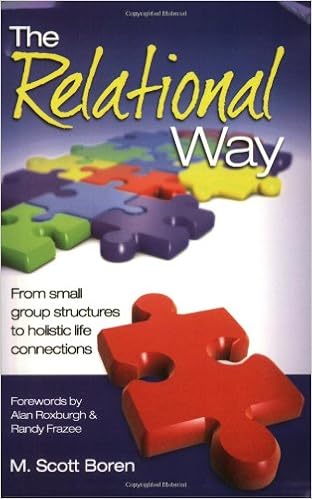
Book Review: The Relational Way by M. Scott Boren


x

Introduction
The best part of Scott Boren’s book, The Relational Way, is on the back cover, which says, “Scott Boren is married to Shawna and the father of three incredible children.  His family participates in the Relational Way with three other families in a small group.”  That immediately drew me into the book.  And then the forward (by Alan Roxburgh) explicitly advises, “This is an important book.  Read it slowly, prepared to have your view of small groups in the church reoriented.” [1]  So that is what I did!  All my books have tons of markings, but this one has more.  It is chock full of nuggets and gospel-centered/missionally-oriented truths mean to transform lives and small groups.

Boren is clear from the get-go: “This book aims to steer your imagination rather than provide answers.” [2]  The way in which Boren approaches the relational way is not merely theological per se but based on an attempt to “…move back into the rhythm of listening to the spirit first.” [3].  In keeping with this low-guidance posture, he offers the following suggestion to his readers,"If you are practically minded by nature, feel free to start with a practical half and then work back through the theological foundation. However, my hope is that you will work through each chapter from the beginning and allow the broad guidelines to stimulate your imagination” [4].

About the Author
Besides practicing what he preaches, Boren was a student of his “beloved seminary professor” Howard Hendricks.  He quotes prof Hendricks, “…pastor should not focus their ministry and teaching people how to do church but on how to do life.” [5]  If prof was on earth today he would be proud.  The reference to Lynn Anderson's they smell like sheep is an indication of his leadership style; namely, he likes to be with his people. [6]  

He directed Research & Development with TOUCH Outreach in Houston, TX and now serves as Community Pastor at Woodland Hills Church in St. Paul, MN.  His writing style is profound and palatable, easy to read, and scripture-based from beginning to end, literally.  Every chapter begins with a “Relational Truth” to replace a “Structural Myth.”

Summary
This book is appropriately titled, The Relational Way and the subtitle is from small group structures to holistic life connections.  Nevertheless, Boren shockingly states,"Small groups were never the focus of the New Testament church!”[7] (emphasis mine)  He explains that the early church met in homes but small groups were never the strategy to grow the church or reach the lost. The early Church did not have official buildings or even societal clout. Homes were simply a target of opportunity.  There is, however, a heavy emphasis on the structure of those House church meetings. Instead of it extensive instruction on how to do “small groups” or “community groups” the New Testament writers’ push was always relationship. "The relational way of the people in the group is what provides the base of life from which ministry occurs. Groups are only a means to the end of a relational life.”[8]

“Missional” is a key word in the Relational Way.  “Missional” is often thought of as reaching those on the outside, but Boren is clear that Missional has a direct correlation to the Missio Dei (the mission of God).  God is on mission and he has a Church to carry out that mission of redeeming and restoring mankind to His image. God is a perfect community and the “small group”/community is a way in which the Relational Way end is achieved.  

Again, God is relational and his kingdom is relational.  The equipping within the community “…impacts more than the scheduled activities of the church by invading the everyday lives of the people of God.”[9]  I heard Pastor Matt Chandler once say, “Life change occurs from life-on-life not sermon on ears!” (paraphrase mine).  What Chandler is suggesting is the deeper life of a “community group,” which is so much more than “attending a service” or “going to church” but rather living life with other people in the community.  Boren sums up God’s relational kingdom succinctly,
It is about doing life together in authentic biblical community and undermining the assumptions of this world that create the anti-relational kingdom. Such small groups don't accommodate the anti-relational kingdom. They confronted, challenges, and offer a different way of living.[10]
In “creating contagious relationships,” he beautifully explains “inward movements” within the small group as,
… the call to love others in the group, to create an atmosphere of true love, acceptance, and forgiveness, to sacrifice for one another, to risk telling the truth to one another, to embrace one another in weakness, and receive the gifts others have to offer. The Inward movement is often called building community.[11]
In sum, the ten chapters in this book are all explicit actions that the group must take in cultivating the Relational Way. 

ApplicationThis is a practical book for congregations of any size.  Here are some questions that I would like to propose for my small group leader to present on our Tuesday night community group of 12-15 people (not including children).

“How do we become the people that live in community that stands in contrast to the social structures of this world? What are the practices of people on the way with God? What ways of living would manifest in being a church on mission with God?”[12] The Relational Way is the way of the Gospel.  And the Gospel is and has always been relevant in America because, as Dallas Willard writes, is “dominated by the essentially enlightenment values that will American culture: pursuit of happiness, unrestricted freedom of choice, disdain for authority.”[13]  

The individualism and isolationism of Americans in the church will always be a potential prophetic moment for the missional-incarnational small group. I think many small groups often struggle with which group they can reach for the sake of the gospel. But, we don't have to go far because individualism and emotional isolationism are so prevalent. Our approach maybe as simple as a gracious reminder that we were never created for individualism and life apart from relationships or emotional isolationism which rejects the notion of life together in community.

InnovationThe dysfunctional lifestyle that Randy Frazee calls “crowded loneliness”[14] is also a target opportunity for if prophetic voice from within the church. We have all been to local church gatherings where somebody feels rejected or isolated for a plethora of reasons. This is not to say at the feelings our reality, but that the environment may act as a catalyst for unresolved conflict in the soul of the individual that feels rejected. I think the antidote too crowded loneliness is perhaps found in intentional/incarnational/missional relational living. It means that I show up on Sunday morning not to be served or noticed, but to serve and notice the marginalized or people who might not fit in with the general population. All this is to say that the opportunity for ministry and the building up, and equipping, and basic encouragement of the Saints is abundant. Once again, we don't have to go far or pray for opportunities for impact when they show up every Sunday morning!

Every local church my family and I have had the privilege to join (which is every two or three years) has had the “mover and shaker” (paid staff member) that carries the bulk of the ministerial responsibilities. Similar to the parable of “Bob” in chapter 3, I've seen so many people who are so busy with ministry and church activities relationships.[15]  I often jokingly ask the “(fill in the blank) director”," where do you go to church?”  And they often laugh (in agreement).

In 2015, we were involved in one the fastest growing church in Rhode Island (OceanPointeri.com) and witnessed first hand how a relational church fought against absentmindedness in ministerial busyness.  Every Sunday morning, 15 minutes prior to the beginning of a service, Pastor Jeff would gather the staff and volunteers and graciously remind them that, "from here on out it's all about people. No tuning instruments. No fixing electronics. Engage people. And find the ones that you do not know.” (Paraphrase mine).  The huddle would break just like a football team!  Everybody had their “game face” on at that point.  For the team at OP, it was all about relationships.  And that is the essence of the Relational Way.

—————————[1] M. Scott Boren, The Relational Way: from small group structures to holistic life connections (Houston, TX: TOUCH Publications, 2007), 9.[2] Ibid., 20.[3] Ibid.[4] Ibid.[5] Ibid., 80.[6] Ibid., 35.[7] Ibid., 24.[8] Ibid., 25.[9] Ibid., 81.[10] Ibid., 79.[11] Ibid., 120.[12] Ibid., 19.[13] Ibid., 75.[14] Ibid., 74.[15] Ibid., 74, 83.


Favorite Quotes
“The fast food way of life also ask as a kind of parable for modern spirituality. It paints a picture for how many people approach God and the church.” 13.

The effects of the Constantinian empire...

“The Church as we know it was built upon the idea of attracting people to attend spiritual events and services.  In other words, people "go to church" and church leaders spend their efforts on developing way to get people to "come to church."  Church is a spiritual service that occurs at a specific spiritual time, at a specific spiritual place, led by spiritual people, for people with spiritual interests.” 15.

“The center of the church has become the Sunday morning event with the goal of making that event attractive enough draw in observers from the culture.” 15.

“Gods sending nature is the model of God that we see in Jesus. God is he sending God.” 19.

“If the church today is to participate in the life of the Trinity, the people of God must learn to shift from a quote come and observe" approach to a"Go and demonstrate" approach.” 19.

“To participate in the mission is to participate in the movement of God's love toward people, since God is the fountain of sending love.” 19

“Today is a day that God is reforming the church. He is calling the church from one place to another, much like he called the Israelite slaves out of Egypt to the promised land.” 20.

“… I cannot be satisfied with a nice small group program in a growing church. He has implanted a call for a vision that will require a lifelong battle." 21.

"Jesus was not trying to impress the crowd, but to usher in  a kingdom.” -Robert Coleman. 41.

“Jesus spent about 50% of this time with the 12 key leaders during his three years of ministry. He spent 35% with the core group/the seventy, and he spent 15% with the crowd.” 42.

"If we don't practice relational community and our leadership, then we should not expect community to results within our groups." 44.

“He is at the center, the spirit of God is released to accomplish the mission of God in this world.” 65.“people grow in their relationship with God when they have the opportunity to process what they are learning with other people." 69.

“the kingdom comes first in order of God, not the church or small groups.” 70.

"it is about doing life together in authentic biblical community and undermining the assumptions of this world that create the anti-relational kingdom. Such small groups don't accommodate the anti-relational kingdom. They confronted, challenges, and offer a different way of living." 79.

Monday, October 16, 2017

Six core functions of community: Fellowship | Confession | Prayer | Exhortation | Worship | Sound Doctrine


Community that fosters confession, repentance, and life together with others is a picture of life on earth as it is in heaven minus the confession of sin.  A community that places emphasis on Kingdom of God-centric prayer will bear fruit in obedience, mutual confession, and worship that pervades every area of life.  Similar to airplane parts, these six core functions are all crucial for kingdom/relational living.  We (humans) were all created as relational beings.

    For the first decade of Pastoral ministry, I preached on repeat: “We cannot apply what we do not know; we cannot know what we do not learn; we cannot learn what we don’t take the time/effort to study.  Therefore, intake of Sound Doctrine is the highest form of worship in this local Church, which prevails over all other activities.”
    This may sound like heresy, but I have moved intake of “Sound Doctrine” from first place to sixth.  Allow me to explain.  While attending school in New England, my family and I belonged to a two-year-old Church plant called, OceanPointe Christian Church.  Nearly everything was different.  The most consistent element to expect the unexpected.  And the model was not to only keep people guessing and impressed, but rather, to cultivate creativity that pointed people to “some guy named Jesus.”  Yes.  We repeatedly introduced the morning with, “We talk a lot about a guy named Jesus…”
    First and foremost, the most life-changing revelation I had was during a sermon series called “Starting Point” (originally written by Andy Stanley).  Pastor Jeff talked about the problem with a “The-Bible-Says” philosophy; namely, that NOBODY in the first century talked like that.  I was completely thrown off because that was my modus operandi for my entire life as a Christian.  Was this blasphemy or truth?  It wasn’t long before it dawned on me.  It was true.  The early Church didn’t have the Bible for hundreds of years, and their faith was not based on a book, but rather an event passed down by word of mouth.  And without “the Bible” Christianity did just fine.  I was never the same after hearing that!  I almost cringe now when I hear someone say, “I only do what the Bible says” or “it’s all about the Bible.”  If they have the same mindset that I had, that means looking down on the importance of prayer and the leading of the Holy Spirit.  Last point on this: the Bible didn’t exist in the Garden, and it doesn’t exist in the New Heaven and Earth.  It must be merely a means to an end for the glory of God here and now.
   As of recent, I have found myself quoting less scripture in exchange for simply speaking the truth without citing the reference. Does it make any difference?  Maybe not.  Truth has been around since the beginning of time.  The “Bible” has only existed since the invention of the printing press in the 15th century.  Since all truth is God’s truth, I simply fire away and let it do its thing.  I think of it as firing a weapon rather than defending the weapons legitimacy.  If I owned a gun, and a dangerous person threatened to kill me and my family, I would not waste a second explaining the legitimacy of my weapon.  I would simply use the weapon to deter the threat and at last resort eliminate it.
    The second earth-shattering event during my time at OceanPointe was learning how to use “I statements.”  It was a Sunday, and the sermon was over.  Just before Pastor Jeff dismissed the congregation, he encouraged us to abstain from talking about the issue of others using “I” statements rather than “them,” “the church,” “us,” “we,” “you,” etc.  When I volunteered to lead a small group, I was given “HomeGroup Guidelines” one of which was “Use I statements.”  I quickly realized that my “confessions” were watered down with the use of “we,” “us,” “the Church,” and worst of all, “you.”  When I started implementing I statements, I started owning my win.  I actually value confession.  
    In my life, “you” statements have been detrimental to my relationships.  I now choose to avoid them, regardless of the context: sermons, one-on-one coffee talks, small groups, and dinner with the family.  Dr. Joseph Umidi says, “The number one killer of authentic relationships: giving advice prematurely.”1  I agree.  Personally, my temptation to use “you” statements or what I call, “preaching talk” is rooted in the stronghold of sermon addiction.  For years I indoctrinated myself with my favorite preachers.  It changed the way I spoke to people.  I had so many memorized sound bites it was equivalent to walking around with a loaded gun with the safe “off.”  I was talking at people rather than fostering friendships and building relationships.  I was inadvertently killing relationships.
    Currently, I am involved in leading a men’s small group at work.  There are 5-9 of us who have committed to meeting regularly.  The group naturally fosters confession, repentance, praise, and worship of Jesus and have naturally been “doing life together.”  This fresh start has enabled me to integrate my re-prioritized values.  The group is dynamic; the age ranges from the late 20s to the late 60s.  Some are passionate to study theology, and others simply want freedom from various struggles.  I admire the advice of “Prof” Howard Hendricks who said, “pastors should not focus their ministry on teaching people how to do church but on how to do life.”2  Scott Boren captures the essence of God’s “Relational Kingdom,”  
It’s about doing life together in authentic biblical community and undermining the assumptions of this world that create the anti-relational kingdom. Such small groups don’t accommodate the anti-relational kingdom. They confront it, challenge it, and offer a different way of living.3
Overall, my six ministry values are in order of sequence.  I believe being surrounded by community (i.e. people who share a common interest) leads to confessions (i.e. ownership of struggles, sins, and confusion), which leads to prayer, exhortation, worship, and back to approaching truth found in scripture that God has given to the Church age in the form of a 66 book bound Bible.  

————————————————

1 Joseph L. Umidi, Transformational Coaching: Bridge Building That Impacts, Connects, and Advances the Ministry and the Marketplace (Place of Publication Not Identified: Xulon Press, 2005), 54.

2 Boren, M. Scott. Relational Way: From Small Group Structures to Holistic Life Connections (Houston, TX: TOUCH Publications, 2007), 80.


3 Ibid., 79.

Saturday, September 9, 2017

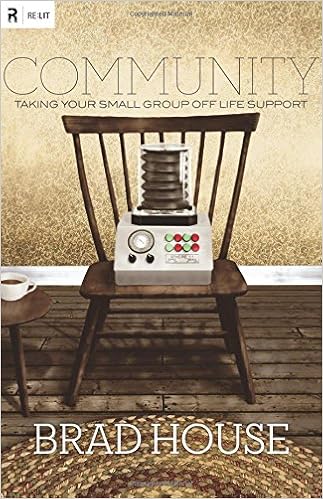
Book Review - "Community" by Brad House

Introduction 
Community is a manual for developing small groups.  It is based on the fact that the church embodies the Imago Dei (i.e. the image of God).  But this poses a question; namely, why are so many community groups or life groups so lifeless?  Brad House lays scriptural foundations underneath community, cites popular models and historical trends throughout Christendom, and concludes his the book with immediate practical application.

Author Information
Brad House pastored at Mars Hill Church in Seattle, WA under Mark Driscoll from 2005 to 2012 and currently serves as executive pastor of ministry at Sojourn Community Church in Louisville, KY.  According to his LinkedIn profile, House developed the vision, structure, strategy, and oversight of 14 Mars Hill churches.  The groups grew from approximately 35 to over 600 groups and 70% participation.  All that to say, he has some clout in regards to community groups in the local church.  I also point out his background not only to reiterative that Community is Biblically based/Gospel-centered/transformational/missional-incarnational/etc, but that it really “works.”  Sometimes the proof is in the pudding.  

Overview of Content 
Community challenges the ecclesiological status quo.  Lifeless communities are the byproduct of groups simply not knowing why they exist.  And the days of equating community group to “bible study” are, in my assessment, over - at least they should be.  Community should be life transforming and gospel centric.  The goal this book is to, “…reestablish the basis for community and why it is, and always has been essential to the Christian life” (p. 31).  
Bascially, sin broke community and broke up the community of the Trinity (i.e. when the Father forsook/abandoned the Son), but the cross restored (and continues to restore) the community of God.  “We are saved to be a community, not a church of individuals” (p. 33).  To put it succinctly, “the purpose of such community is to display the love of God for the world!” (p. 34, exclamation mine).  I love it whenever someone says, “it’s not about me!”  I am in full agreement that “Community groups are a living illustration of the gospel and its power to save” (ibid.).  
The book is broken down into three parts with an appendix loaded with practical application.  Part one is labeled The Foundation: Building Blocks For Life.  Part two is the Health Plan: Redefining Community Groups.  Part three is Treatment: Effecting Change in Your Groups.  I will highlight the foundational aspects of the book since I believe the practical application will flow out of the freedom that comes from a refreshed/fresh perspective on community.

Scriptural Foundation for Community
House cites Ephesians 2:15b-22 to point out the intentionality behind the cross in building (or rebuilding) the community of God (see p. 33).  Colossians 3:12-17 paints  “… a picture of a community reflecting the attributes of God because of what Jesus has done” (p. 36).  It is the community that allows the believers to reflect the relational nature of God, which is marked by grace and mercy.  Last, but certainly not least, 1 Peter 2:9-12 is one of Brad’s “favorite pictures of who we are to be as a community” (pg. 39).  This passage describes a community of people transformed by the gospel.  
And with these foundational scriptures in mind, “Our primary purpose in community is not that our needs are being met, but that Jesus would be lifted up…we experience our greatest joy hone Jesus is most glorified” (p. 41).  And the best part about the neighbors witnessing a gospel-centered community is that they see good works and praise their Father in heaven!

Missional-Incarnational Focused Community
Two prominent missiologists that House references are Ed Stetzer and Alan Hirsch, both of which have conveyed that the church does NOT have a mission, but rather the mission has a church.  I want to emphasize this part of the book because I believe the mission and the missional church answers the “why” that keeps the “lifeless communities” lifeless.  At the risk of sounding simplistic, the mission to which the church is called is to display the love of God for the world (cf. p. 34).
I think it is also important to stress the missional aspect of community because it frees up the community to be on mission with God and not the other way around.  It sets the group free from thinking that the gathering is about focusing on people, but rather focusing on the gospel and the implications that flesh out in community groups.
With that in mind, House defines missional as, “…[participation] in the mission of God as a response to the gospel through proclamation and practice” (p. 67).  Since creation and restoration are the bookends in God’s story of redemption of fallen creation, community participation in the mission of God has everything to do with participating in God’s restoration of people in group settings.  
House quotes Hirsch’s observation that “every revival in history has been a recovery of the ‘people of God being the people of God’” (p. 81).  This just means that a bunch of people realized the truth of their identity in Christ and went nuts with it!  And why wouldn’t they!?  It is an amazing day when one realizes his or her identity is not just strong, but Jesus-strong!
After the portion on mission, House moves into part II and III, which deals with historical/currents and application.  For that reason, I’ll shift to my critique of the book.

Critique
The section on identity (chapter 4) is too short.  I can’t get enough of hearing who I am in Christ.  Identity is the foundation for everything we do.  We are not our own. We have been crucified with Christ and no longer consider our ways/rights/attitudes something to highlight, but rather who Christ is in me.  Far too often believers identify what they do/have done rather than who Christ is in them.  
I said something bold last week to a few pastors: “I died to myself and therefore I don’t get a vote anymore.  Christ is my new life and the old me has died.”  One pastor replied, “yeah but you still get to be human.”  What does that mean?  I have no idea because I was crucified with Christ and I no longer live, but Christ lives in me.  Last time I checked, dead people don’t get a say in anything.  How many rights does a slave have?  Not many.  We are slaves of Christ and bound to righteousness.  I would like to heart this language in more books like Community.
I think the community group would do well to think in terms of literal community.  If sin is to be put to death, let’s do it as a community.  A manual on the community should include the children in the rhythms of the community.  Let the little children draw near.  Let the children see just how much mommy and daddy and uncle and aunty need the Savior.  And when they see just how much we are a community in need of a Savior, we let them know the gospel; that is, WE DON’T NEED JESUS, WE HAVE JESUS.   I know this sounds different, but let’s change the way we talk.
As straightforward as the book is, the church/community groups could use more encouragement in reiterating the freedom of no condemnation in Christ.  If that is true, we need to hear more and more about confession and renouncing the language of “be careful,” “be cautious” and be bold and courageous.  God has not given us a spirit of “be-careful-what-you-share-in-community-group-because-people-might-take-it-the-wrong-way.”  It’s time to let God be our fortress and defense and reject any temptation to be our own defense.
Conclusion
I love this book.  It offers a robust look at the biblical/gospel-centered community.  It offers a balanced and straightforward assessment of small groups.  It should convict small groups who only swim in the deep and it should encourage others to move from the kiddie pool to deeper parts of the pool.  All in all, I think this book encourages people to dive into community.  There is much to do and none of us have any time to waste.

Favorite Quotes

  • “…community is not about us; it is about God” (p. 19).
  • “Community is an instrument of worship, a weapon against sin, and a tool for evangelism - all for the exaltation of Jesus” (p. 19).
  • “Jesus gives us the ability to experience life as God intended, in real community with him and another” (p. 33).
  • “Community is for us a declaration of the overwhelming love of God, the tangible proclamation of the reconciling work of the cross” (p. 34).
  • “Because Jesus has redeemed us, we can reset our identity to reside in the place God intended” (p. 35).
  • “Our primary purpose in community is not that our needs are being met, but that Jesus would be lifted up. It is not that we aren't blessed by the love we share for one another, but that we experience our greatest joy when Jesus is most glorified” (p. 41).
  • “… what is the ultimate goal of our neighbors seeing how we live? It is so they will worship God!” (p. 41).
  • “Isolation is a response to sin. Community is a response to reconciliation” (p. 42).
  • “Our communities should be the most powerful expression of the gospel within the church” (p. 45).
  • “There is no biblical support for personal, autonomous Christianity” (p. 47).
  • “Don’t just tell your church what to do; her Mind them of who they are and what Christ has done” (p. 72).
  • “Ownership looks like people participating in the messiness of community and being inconvenienced for the sake of another's sanctification” (p. 73).
  • “Because Jesus has redeemed us and reconciled us to the Father, we get to live in such a way that shows his great mercy and grace” (p. 75).
  • “Man has always had a bent toward worshiping created things rather than the creator. This is the definition of idolatry” (p. 90).